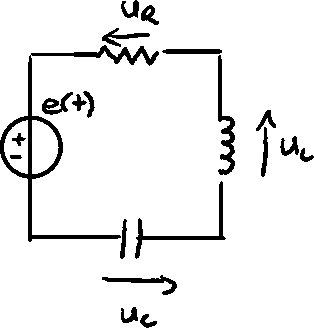
Resonance

A resonant pulsation of one port is ω0 such that |Z(ω)| attains at w0 a proper local minimum or maximum

|Z||Z|2|1z||Y||Y|2

Resonant pulsation is a ω0 for which impedance becomes purely real
ω0=2πf0

Q factor

Q factor related to resonant pulsation is

Qω0=2πWmaxω(0,T),T=2πω

where ω(0,T) is energy transferred to one-port in T, and Wmax is maximal (over T0) value of energy stored

Series Resonant Circuit (SRC)
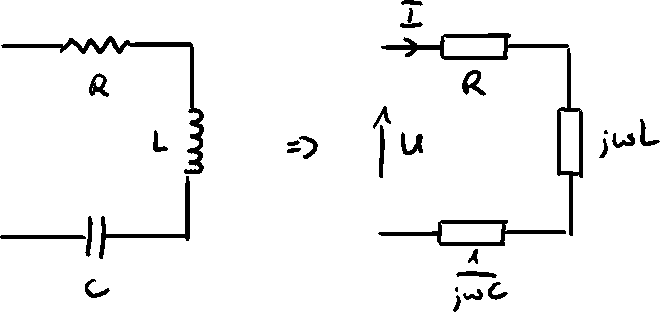
rM drawing 2026-01-17-20.00.55.png|400
Z(ω)=R+jωL+1jωC=R+j(ωL1ωC)
|Z(ω)|2=R2+(ωL1ωC)2=R22LC+ω2L2+1ω2C2
0=d|Z|2dω(ω0), so 0=2L2ω02ω03C2ω0=1LC
Z(ω)=R+j(ωL1ωC)=R+1ωCj(ω2LC1)=ω0=1LCR+1ωCj(11)=R+0=R
Q=2πWmaxω(0,T)

Real power

Pw=12|I|2Re(Z(ω)), so ω(0,T)=πω0|I|2R
Wmax=12max(LiL2(t)+CuC2(t))=|I|22ω02C
and finally
Q=1ω0RC=LCRρ=LC characterisctic resistance of SRC

Absolute detuning

For SRC, absolute detuning related tu pulsation ω is defined as ξω=(ωL1ωC)1R

Filtration

For resonant pulsation ω0(ξω=0), i(t)=EmRcos(ω0t)
rM drawing 2026-01-17-20.01.09.png|200
UR(t)=Emcos(ω0t)
UL(t)=QEmcos(ω0t+π2)
UL(t)=QEmcos(ω0tπ2)

Relative pulsation related to pulsation ω is
νw=ωω0ω0ω, and so ξω=Qν

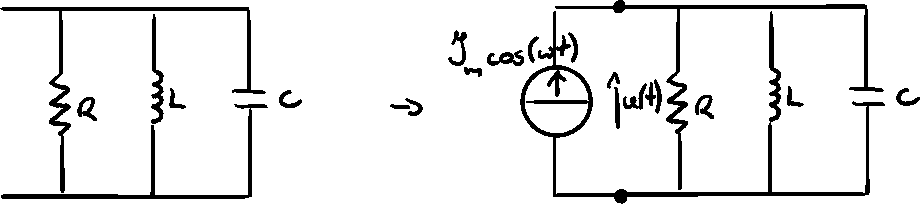
Parallel resonant circuit (PRC)

rM drawing 2026-01-17-20.17.14.png
Y(ω)=1R+1jωL+jωC=1R(1+jR(ωC1ωL))
Zω=R1+jξω
Q=Rω0L=ω0RC=RLCρ=LC characteristic resistance of PRC

Absolute detuning ξω=R(ωC1ωL)
Relative detuning νω=ωω0ω0ωξ=Qν
Current resonance (for ω=ω0) - u(t)=ImRcos(ω0t)

ir(t)=Imcos(ω0t)iL(t)=QImcos(ω0tπ2)iC(t)=QImcos(ωt+π2)