jesien.net
Search
CTRL + K
jesien.net
Search
CTRL + K
Home Page
University
CSCI321
CSCI321
Chapter 1
Chapter 2
Chapter 3.6
Chapter 3
Chapter 4.6
Chapter 4
Chapter 5
Chapter 6
Chapter 7
Chapter 8
Chapter 9
ENG101
ENG101
INF101
INF 101
Art Description
Assignment 3
Assignment
Music Essay - Formatting
Reading journal
Reading New York Times
Snopes - fake news
Songs Analysis
Writing 1
ENG102
Profile Essay
INF250
1 - Web Design & Development
2 - HTML Basics
3 - HTML Elements
INF 250 - Introduction to Web Development
MATH250
MATH250
1 - Definitions, Inferential statistics
2.1 - 2.4 - Distributions and graphs
2.5 - Descriptive statistics
2.6 - Measures of dispersion
2.7 - Connecting measures together
2.8, 2.9 - Measuring grouped data
3.1 - Introduction to probability
3.3 - Compound Events
4.1 - Random Variables
4.3 - Binomial Random Variable
4.6 - Continuous Random Variables
5 - Sample Distributions
6 - Inferential Statistics
7 - Hypothesis Testing
8 - Bivariate Data and Correlation
Exam 2 Prep
MATH250 Study Plan
POLS101
0 - Political Science
1 - Early Beginnings
2 - Federalism
UNIV199
UNIV 199
WUT
EADS
Algorithms and Data Structures
Laboratories
Binary Tree
Linked list
Ring
Tutorials
Iterator
Recursion
Single Linked List
Algorithm analysis and classes
Array-based lists
Basic principles of OOD
Linked Lists
Recursion
Standard Template Library
ECIRS
Circuits and Signals
AC Analysis
AC Power
Basic components and laws
DC Analysis
Equivalent Devices
Power and energy
Resonance
Tutorials
ECOAR
Computer Architecture
0. InitLecture
1. Basics
2. Data
3. Requirements of HLL and application synthesis
4. Structure of an application programming model
5. Application programming model
6. Execution unit
7. Pipeline execution unit
8. Multipipelined (superscalar) processors
9. Caches
11. Resource management and protection
12. Memory management
13. Exceptions
14. Input-Output
ARM Architecture
Assembly Cheatsheet - RISC V
Final prep
L1. Introduction to assembly and hybrid programming
L2. Program creation process
L3. Assembly programming in OS environment
L4. Hybrid programming
L5. Assembly programming techniques
L7. x86 architecture and programming
Practical exercises
Sample questions
x86 Hybrid Programming
x86 Instruction Set
x86 Programming
EDC1
Digital Circuits
Asynchronous circuits
Combinatorial Logic
Fundamentals of Logic Circuit Design
Iterative circuits
Sequential logic
EDDE
Differential and Difference
Lectures
Tut 1
Tut 2
Tut 3
EECEL
Electrical and Computer Engineering Laboratory
EOOP
Object Oriented Programming
Classes II
Midterm test 1
Preliminary Project - Basics
Project - Taxi Agency
Project Whitepaper
Non-Tech
Spanish
3.11
20.10
24.11
27.10
Spanish
Culture and Tradition - revision
Culture and Tradition
Project Management
Quantum Physics - High School
Lectures
Linear differential equations (
1
s
t
order)
Linear y
no
y
2
,
y
,
(
y
′
)
3
,
1
y
,
sin
y
,
…
a
(
x
)
y
′
(
x
)
+
b
(
x
)
y
(
x
)
=
c
(
x
)
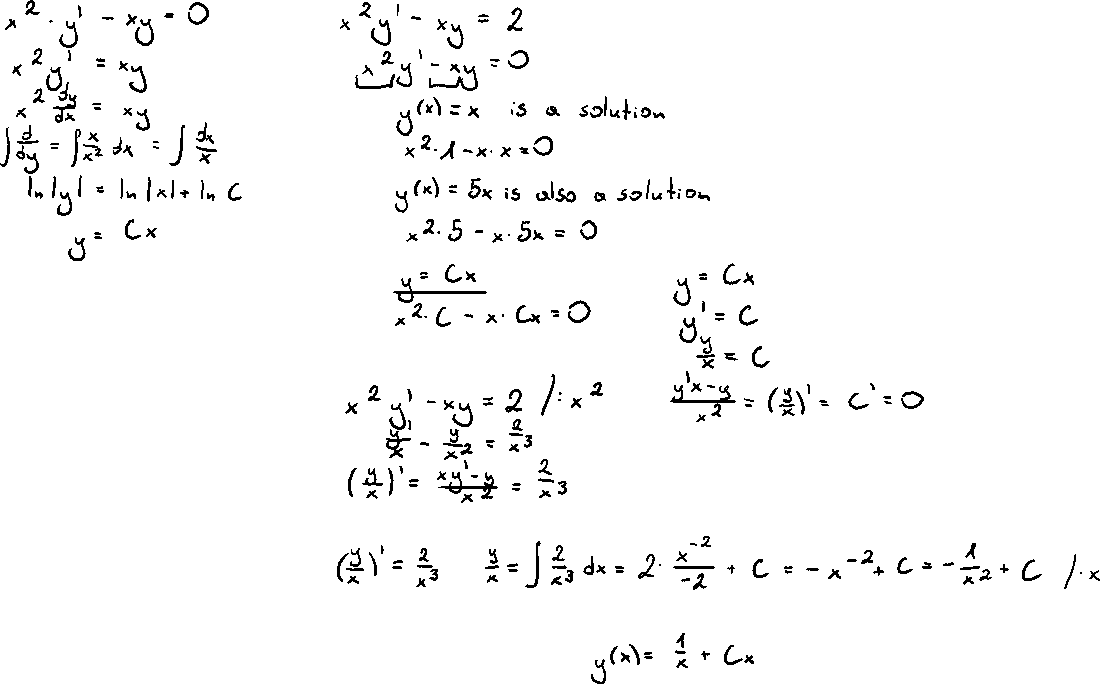
Homogenous linear equations
a
(
x
)
y
′
(
x
)
+
b
(
x
)
y
(
x
)
=
0
a
(
x
)
d
y
d
x
=
−
b
(
x
)
y
(
x
)
ln
|
y
(
x
)
|
=
∫
d
y
d
x
=
−
∫
b
(
x
)
a
(
x
)
d
x
=
⋯
+
ln
C
y
=
C
e
−
∫
b
(
x
)
a
(
x
)
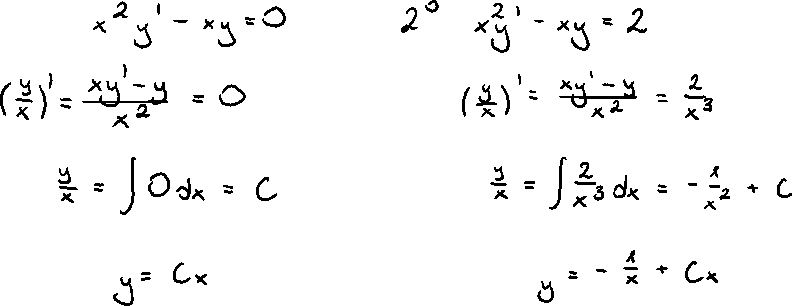
Example
Typical notation
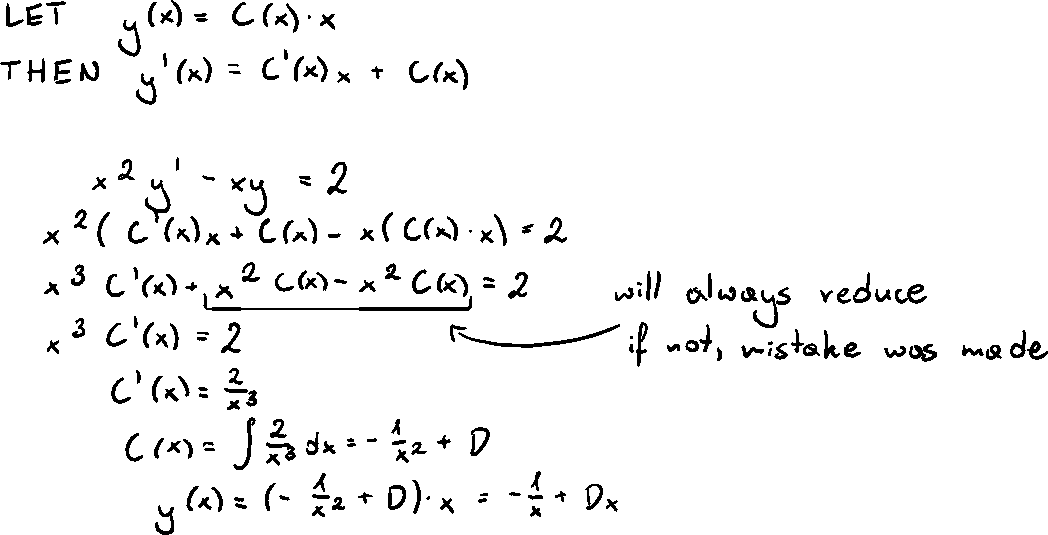
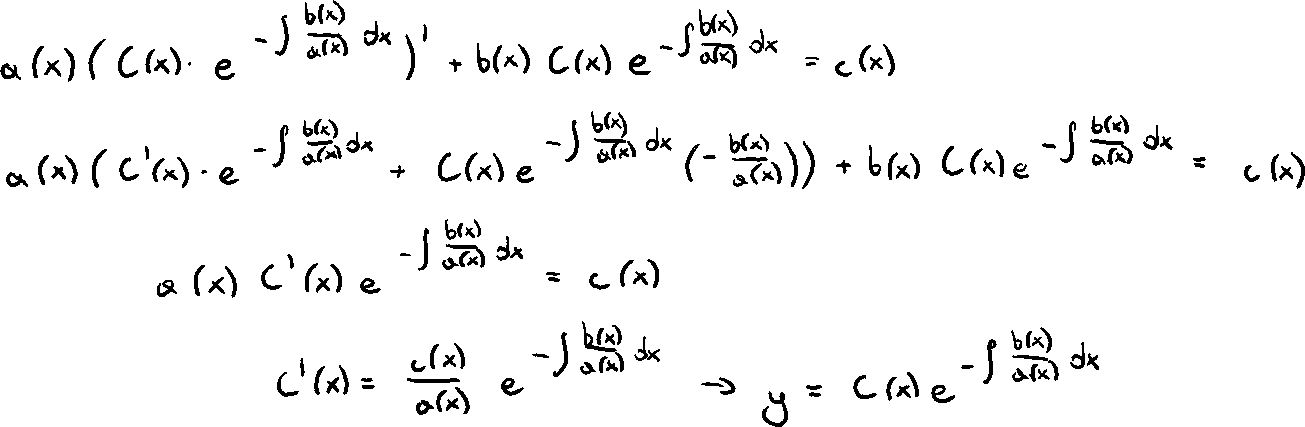
Method of variation of constants
Knowing that
y
=
C
e
−
∫
b
(
x
)
a
(
x
)
d
x