4. Structure of an application programming model
Application programming model
Set of logical resources presented by the computer to HLL compiler or a programmer writing the application program in assembly language
Also called 'user programming model'
Components of APM
Processor
- register set - number of registers and their functionality
- addressing modes - methods of specification of instruction arguments
- conditional operation model - implementation of conditional operation (if-then-else etc.)
- instruction set - set of operations performed by the processor
Virtual memory - The 'memory' visible in an application programming model is a virtual memory layer of memory hierarchy
- Set of virtual addresses ranges available to applications
Composition of a programming model
All components are closely connected
it is not possible to design one component independently from the others
Programming model is usually associated with underlying hardware implementation
Registers
Register functions
Accumulator - may server as both source and destination
Address register - holds address component. Specialized:
stack pointer, frame pointer, static base pointer, return address/link register
Loop iteration counter
General-purpose register - may be used as accumulator and address register
Register set architectures
Architectures without registers
Must contain 1...3 registers, including PC
Data operations 'memory to memory
Move architecture - some locations of address space implemented as registers
registers hidden behind memory locations
special register write starts arithmetic or logical operation
one location mapped to PC
Minimal register set
PC, SP, Accumulator, Address register necessary for data structure accesses
Small set of specialized registers
6...8 registers with various fixed functions
Cannot be efficiently used by compilers
example - Intel 8080/8085
Small set of general purpose registers
6...8 general purpose registers
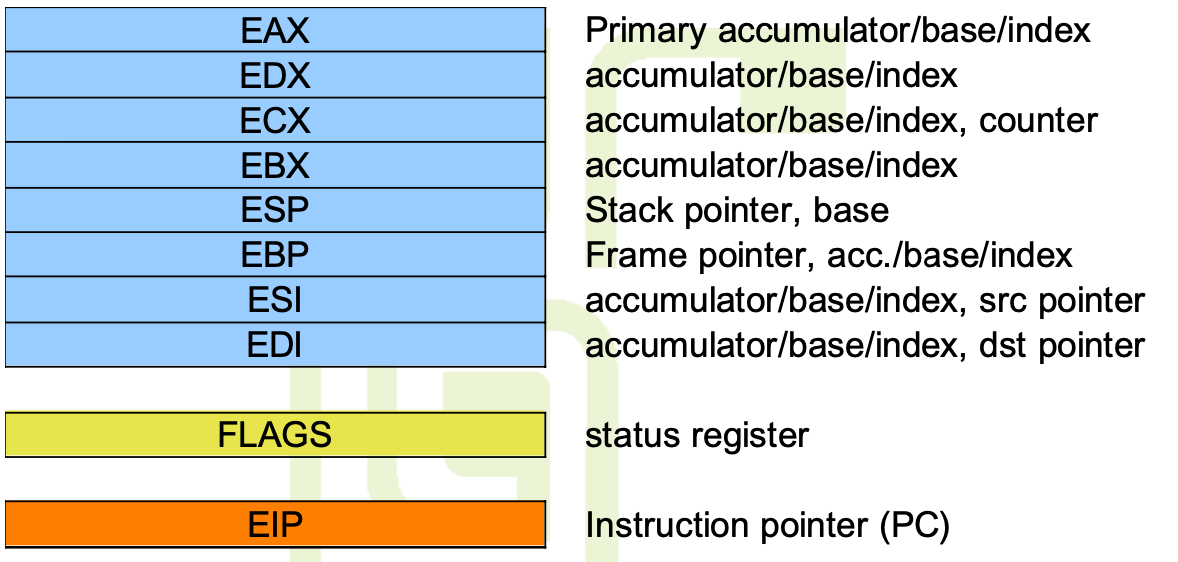
Example - x86 in 32-bit mode
8 registers - EAX, EDX, ECX, EBX, ESP, EBP, ESI, EDI
All registers can be used as accumulators and address registers, all except ESP as index registers
3...4 registers may be used for storing local variables of arguments
Big set of general purpose registers
16 or 32 general purpose registers
Registers are used for argument passing and local variable storage
Top-of-stack buffer
Big set of g.p. registers (32...128) designed to store major part of a stack frame (excluding structures)
Subroutine's body may be executed practically without memory references
Stack-based register set
Stack of 3...8 registers
Registers may have no names
All operations performed on top of stack
no explicit arguments or single argument
arguments popped from stack, result pushed onto
Addressing modes
Method of computing the address of a memory argument
Addressing modes not referencing memory
Register direct - argument contained in a register
mov eax, ecx
Immediate - data value (constant) contained in the instruction
mov eax, 123
Register indirect modes
Argument in memory, address of argument or its component placed in register
The register containing address - base register
Variants:
- Simple r.i. - address in a register
mov eax, [ebx] - r.i. with displacement - sum of register content and a constant
mov eax, [ebx + 4] - double-register indirect - sum of two register
mov eax, [ebx + ecx]
Minimal set of addressing modes
Only three addressing modes are necessary for efficient implementation of HLLs:
- Register direct
- Immediate
- One of r.i. modes (usually r.i. with displacement)
Absolute (direct) mode
Data in memory, address contained in the instruction
mov eax, [x]
x is a name of variable, converted by assembler into a constant address value
the easiest method of static data addressing
unnecessary - may be replaced by r.i. with displacement
PC-based modes
r.i. using PC as base register
Indexed modes
Address obtained by adding the address generated using some of the previously presented memory addressing modes and value of index register, optionally multiplied by a constant scale factor (power of 2)
mov eax, [ebx + ecx * 4]
register is called index register
scale - 1, 2, 4, 8, or 16
Multiplication implemented as left-shifting
Scale == 1 - double register indirect mode
Scale != 1 - scaled index mode
Examples
[table + ecx * 4] - absolute indexed
[ebx + edx * 2] - register indirect indexed
Register indirect with base automodification
Modifies the content of a base register by adding or subtracting the size of memory data being accessed
preincrementation ++i
postincrementation i++
predecrementation --i
postdecrementation i--
Stack operations make an implicit use of these modes, for full descending stack:
PUSH - predecrementation
POP - postincrementation
Memory indirect modes
Data in memory at the address, which component is also placed in memory (pointer variable). Two references:
- To access address component (ptr var)
- To access the target data
Useful with table-of-pointers type structures
Conditional operations model
Implementation of conditional operations
Variants:
- Model with flags
- Model without flags ('compare and...')
- Predicates
Conditional operations
Describes the implementation of conditional operations
Variants:
- With flags
- Without flags
- Predicates
Conditional operations using flags
Flag - single bit register storing the attributes of the recent operation result
Available flags:
- Z - Zero
- N/M/S (Negative/Minus/Sign) - sign
- C/CY - Carry
- O/V/OV - Overflow
- AC/HC (auxiliary/half carry) - BCD carry
- P - Parity
AC/HC and Parity is not used anymore (still found in x86)
Flag setting rules
All rules are described in the processor documentation
All flags are set by basic two-argument arithmetic and logical instructions
Other instructions (like single-argument) may set only some of the flags
I
n some architectures (M68k, HC08), Zero and Sign flags are set by data transfer instructions
Intel decided not to set those flags
Special instructions may only set the flags not affecting any other registers (in x86)
- Arithmetic compare - CMP (subtraction without storing the result)
- Logical compare - TEST (logical and without result store)
Conditional instructions
Specifies the condition for its execution
Conditional jump/branches - available in almost all archs.
Conditional skip - skip the next instruction (usually in very simple archs.)
Conditional data moves - available in newer archs
Conditional set instruction
Conditional execution of all or most instructions (ex. ARM)
Conditional operations without flags
Single instruction evaluates the bool value of a relation between data and executes some operation is true
ex. "jump if two registers are equal"
Typically found in simple RISC architectures like MIPS and RISC-V
Predicates
Generalized flags, storing logical values of several previously evaluated relations or expressions
- Evaluate results of conditions in predicates:
- save a < b in pred1
- save c >= d in pred2
- save e == f in pred
- Execute based on predicates
- jump if pred2 is true
Conditional operations in vector unit
if - then - else implemented as selection between two possible results (a, b) for each vector element
x = <cond> ? a : b;
a and b vectors are computed first