Electrical and Computer Engineering Laboratory
Measuring process
- Source of the measured quantity
- Converting the measured quantity into quantity being transmitted or compared
- Sensors
- Signal converters
- Signal conditioning devices, adapters
- Objective comparison system
- Comparator
- Measurand standard (reference)
- Actuators - compared quantity as an observable one (display)
- Information receptor (human)
Disturbances can impact any of the processes:
- Noises
- Environmental effects
- Insertion errors
- Conversion errors
- Instrument errors
- Data processing errors
- Read-out errors
Precision vs Accuracy
Precision:
- discrimination - measuring instrument reacts to small changes
- repeatability - data are close in the same conditions in small period of time
- reproducibility - consistent results in the case of repeating the measurement after a long period of time
Accuracy: - Measurement correctly indicates the true value of the quantity
True value (
Measurement error - quantitative expression of measurement uncertainty. algebraic difference between the measured value (
Measurement errors
Basic classification
With reference to the true value
Absolute
Relative
With reference to the pattern of occurrence
Inappropriate - inaccuracy of instruments
Acquisition - interaction of instrument and measurement circuit
Residual error & measurement uncertainty
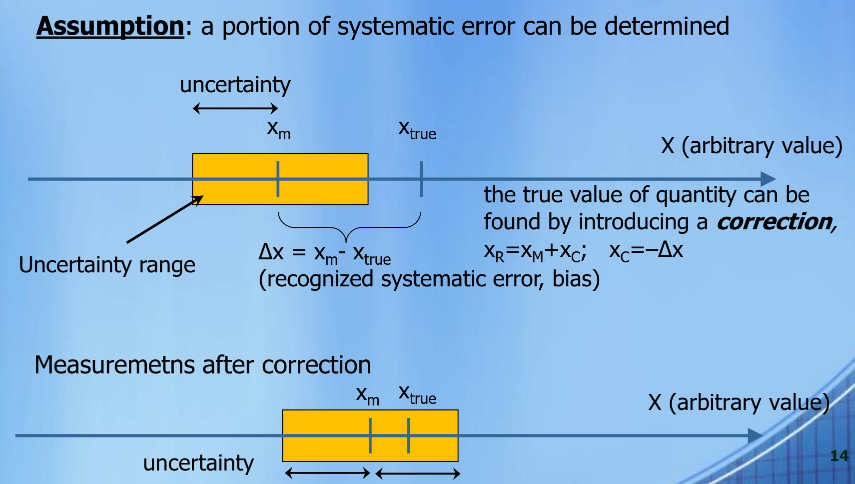
Assumption - a portion of systematic error can be determined
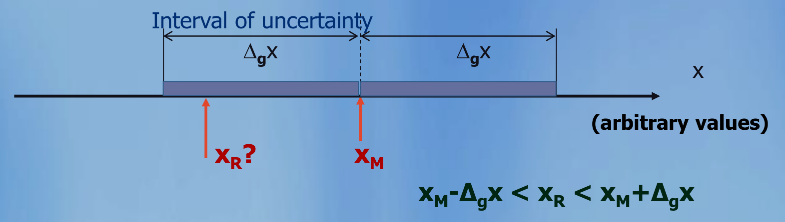
Limiting error
Assumption - interval of uncertainty is symmetric about the measured value
One can say with extremely high probability (~100%) that the true value of a quantity lies within this interval
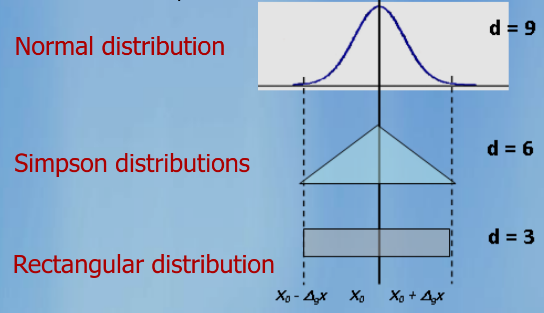
Terminology
Uncertainty
Type A
calculated from series of repeated observations (n>=4)
Mean value
Standard deviation of single measurement
Standard deviation of a series of measurements
Type B
evaluation of uncertainty by means other than the statistical analysis of series of observations
Significant figures
Nonzero integers always count as significant figures
Leading zeros do not count as significant figures
Captive zeros - always count as sign. figures
Training zeros - significant ony if the number contains a decimal point
Mathematical operations
Multiplication and division - sign. figures in the result equal the number in the least precise measurement used in the calculation
Addition and subtraction - number of decimal places in the result equals the number of dec. placesin the least precise measurement
GENERALLY uncertainties should be rounded to one (max two)significant figures
The latest sign. fig. in any stated answers should be of the same order of magnitude (in the same dec. position) as the uncertainty
Writing results
Instrument error (accuracy)
Class index of an instrument is the lowest number from the series
where
This applies for analog read instrument
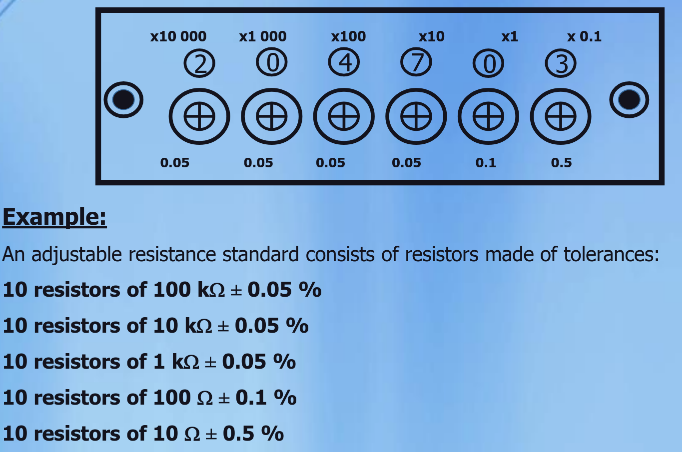
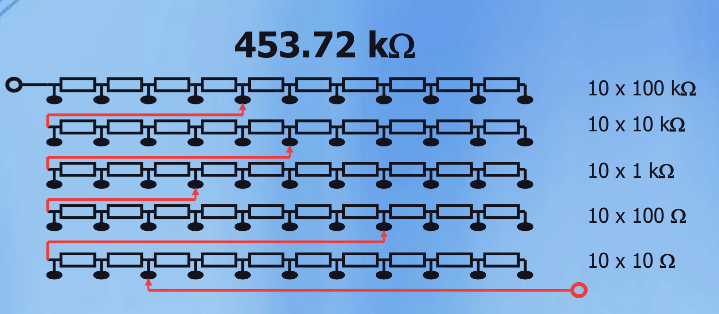
Example for a decade box
Digital read-out
where:
- b - zero error
- a - full scale error
Alternative definition:
Precision of digital read-out
174.358V - Precision of the result
It is precision not accuracy of the measurement
Fundamental formulae
When the result of measurement depends on one variable only
Absolute error -
Relative error -
Error summation law
The symbol