2 - Federalism
Federalism is a system where the decision making is at both federal and sub-national level (in the U.S. - within the states)
Four Central Ideas
- The Constitution established a federal system - the division of power between the national and state governments
- The national and state governments compete for power, but the national government has the winning record
- Crises, technological developments, and differing political ideas cause power shifts between national and state government
- A federal system has strengths and weaknesses
Federalism
Federalism - the division of power between the national and state governments
Evolving relationship impacted by:
- An emerging crisis (COVID, wars)
- Technological progress has made it easier for subnational government to provide services and implement policies quickly
The national government has power to impact laws on environment, income, general housing, education, etc.
If states take some of the responsibilities on themselves, and away from the central government, the central government is losing power
Double Security
James Madison (Federalist no.51)
- Federalism protects citizens from tyranny by splitting power between state and national governments
- Separation of Powers protects citizens from tyranny by splitting power between a legislature, executive, and judiciary
Dual Federalism
First system of federalism in the U.S.
Dual Federalism (1789 - 1930s) - clear divisions between state and national government
National government
- Negotiating treaties
- Regulating commerce
- Military protection
State Government - most powers are held by the states in this period
The line between state and national governments' powers was clearly drawn. State was not doing anything that national was doing, and vice-versa
Federal government was not involved in education,
Commerce Clause
Article 1, sec. 8 of the Constitution, grants Congress the authority to regulate commerce
Foundation for expanding the power of national government
Government can regulate anything that might have inter-state commerce
Establishing Cooperative Federalism
The New Deal - ushered in Cooperative Federalism
Response to the economic crisis of The Great Depression (1929 - 1939)
FDR pushed to expand government by threatening to stack the Supreme Court
Stacking failed, but pressured Congress to support his programs
As part of helping people, the national government created public housing
Cooperative Federalism & the Commerce Clause
Cooperative Federalism was supported by a change in the approach of the Supreme Court
In 1916, the Supreme Court struck down a law to set national standards for child labor
After The Great Depression, the Supreme Court supported legislation for national child labor standards using the commerce clause as support
Congress essentially is given the power to regulate any activity that crosses state lines
Previously, Supreme Court said interstate commerce was regulated by national government, but not innerstate. Now, if the commerce/act has a possibility of crossing state lines - it can be regulated by the government
Cooperative Federalism at Work
1930s - 1970s is when MANY issue areas were seen
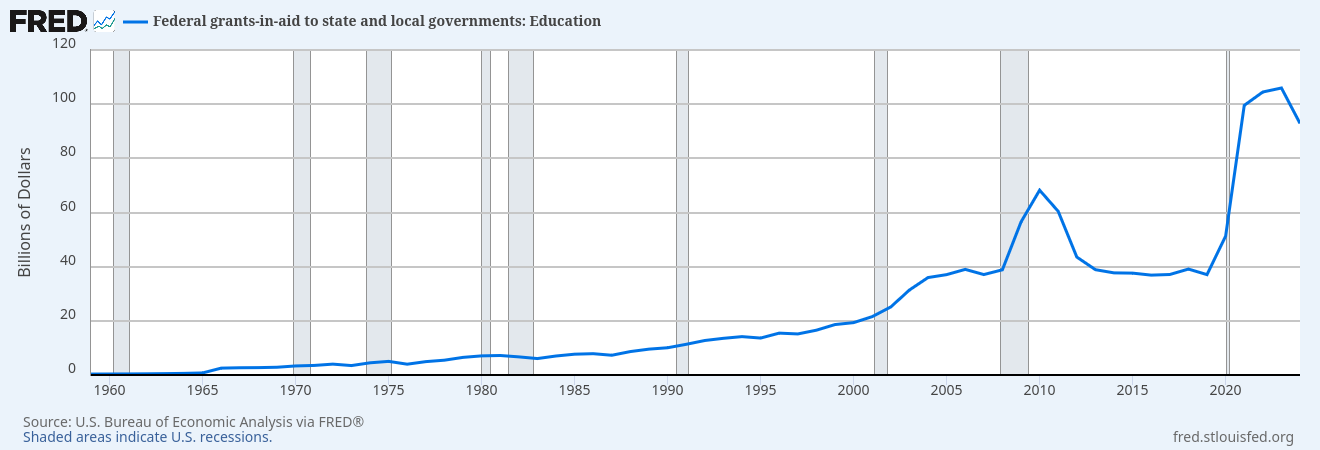
Grants-in-Aid - federal funding given to state and local government
Incentives for state and local government to participate in national programs
The more money the central government gives out to local governments as 'aid', the more say it has when it comes to education
Visualising Dual and Cooperative Federalism

Coercive/Creative Federalism
Marked by transition of national power from economic to social issues
In 1960s, Supreme Court rules that business selling goods across state line could not discriminate against African Americans
Social Issues
- Racism
- Crime
- Environmental Issues
Examples - there was a national-set speed limit. If states wanted to change it, the government warned that they will lose transportation grants funding roads, etc.
Rise of Unfunded Mandates
Federal standards or programs that require states to take particular actions but do not provide state governments with the funding to meet requirements
Unfunded Mandate: Medicaid
Federal Government:
- mandates that every state must operate Medicaid programs
- sets minimum benefit and eligibility standards
- reimburses states for only half of the program's annual cost
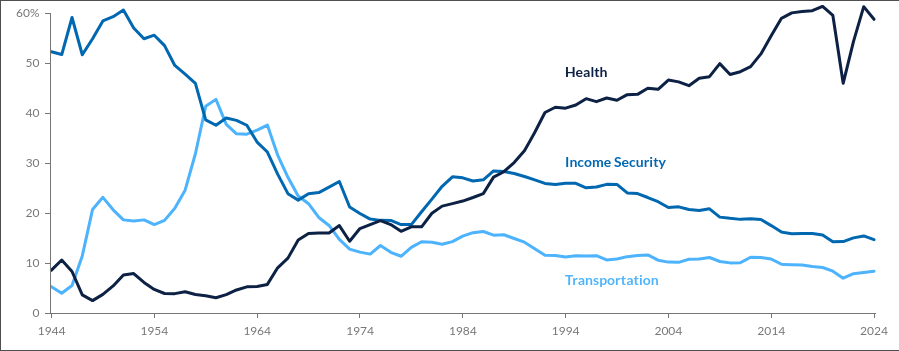
Federal Grants
Since 1950, the share (not the amount) of money going to health has been increasing, while the income security and transportation has been going down
Washington, DC has the biggest percentage of total revenue coming from the federal government
New Federalism
Devolution - reassigning power from the national government back to the states
Protection of states' rights
Attempted reduction in unfunded mandates
Roots of New Federalism
Dissatisfaction with growing use of unfunded mandates
Policies of Ronald Reagan
Republican Revolution
1990s Supreme Court decisions that supported states' rights
U.S. v Lopez (1995)
Resticted interpretation of Commerce Clause
Struck down the Gun-Free School Zone Act of 1990
U.S. Government said that policy trying to remove guns from schools involved inter-state commerce, so it can regulate it - prohibit guns
Overly broad intepretation of the Commerce Clause
Grants
Categorical grants may be spent only for narrowly defined purposes. These grants also often require some commitment of matching funds. With matching funds, the recipient of a grant needs to controbute some of the resources (in order to show commitment)
Block grants give the recipient much greater flexiblity in terms of having less stringent requirements. The recipients have greater flexibility in using the funds
Competetive Federalism
With competetive federalism, some policy issues, such as immigration have been redefined. The reason is that the roles that states and the federal government play in these policy areas have changed
Immigration and Federalism
Since the late 1990s, states have assered a right to make immigration policy based on the premise that the are merely enforcing, not supplanting/overriding, the nation's immigration laws
In 2012, in Arizona v. United States, the Supreme Court affirmed federal supremacy in establishing rules and regulations on immigration
Raising Attention to New Issues Under Federalism
By creating two institutional access points - the federal and state governments - the system of federalism allows for interest groups such as Mother's Against Drunk Driving to strategize about the best way to achieve their policy objectives. State legislators were unresponsive to MADD, so MADD went to the federal level
The U.S. Government said, that if states will not comply with the minimal drinking age, it will not give them infrustructure aids
Venue Shopping - choosing state or federal, and hoping that they will listen to your need. If not - go the the other part.